Model Green Hotel—Putting the “Green” in Greensboro

[This article was originally posted on June 7, 2010]

This Sunday’s N&O featured a piece on the Proximity Hotel in Greensboro, NC.  Developer Dennis Quaintance is the man behind the hotel, which is the first hotel in the country to obtain a Platinum LEED rating.  According to its website,  the Hotel was built to use 40% less energy and 30% less water than a comparable hotel.  Innovations include  a unique elevator design which captures and reutilizes the system’s energy expenditure as well as 100 rooftop solar panels to generate hot water.

In stark contrast to the recent Town of Cary decision  to forego LEED certification for its new fire department building, the Proximity Hotel has spent approximately 3% extra to obtain its certification.  Developer Quaintance expects to make the money back, through a combination of energy efficiency and state and federal tax credits, as early as 2012.

If more developers calculate that they can make more money through the LEED program, expect to see more LEED certified buildings in the future.  For now, however, two years after the Proximity Hotel first opened, there is only one other platinum hotel in the U.S.


How to Smartly Handle Project Documents

mountain of construction paperwork

Paperwork by luxomedia via Flickr

In the Contract Risks Management Group on LinkedIn, L.H. Chin wrote an article about file keeping for contract risk management.  Basically, his premise is that if you cannot keep your Project files orderly, you have exponentially increased your chances of a problem later.   His particular example dealt with originals versus reproduced copies, which is only somewhat germane to North Carolina contracts.  (Here, copies can be used as evidence most of the time—though not always).  His main point, however, about the ability to minimize future risks by having good document control policies in place, is something every project manager should think about.

 Here are a few tips of my own in that regard:

1.   File all communications in one place.  Don’t keep faxes in one file, email in another, and letters in a third.  Don’t keep incoming and outgoing correspondence separated by vendor.  Keep it all in one chronological file.  If you ever find yourself needing legal assistance, this will save many hours and untold stress for everybody.

1.b.  Caveat:  don’t feel like you need to print out every email.  Do, however, maintain a separate email e-folder for the Project, and go ahead and print those really crucial, smoking gun emails.

2.  If you insist on violating Rule 1 (and I know those of you who read this blog would never consider such a thing, right?):  Have all the files, categories, and such you want, but please also make a “master” chronological file of all correspondence.   Just do it.

3.  If you have any communications with your lawyer, an insurance representative (outside of the normal bonding paperwork), or otherwise have documents relating to potential claims, do keep them separate.  Put all such correspondence, in a folder marked “legal,” away from the Project file to prevent inadvertent disclosure to anyone else if there is ever litigation on the matter.

3.b  If in doubt whether something should be in “legal” or “correspondence”, err on the side of “legal.”  Your attorney can always change the classification later, but she can’t put the genie back in the bottle if something that is privileged is mistakenly given to a party suing you.

If you have any questions about these tips, or want to discuss your current procedure for record management, shoot me an email.  My contact information can be found on my Firm bio or at the Footer of the Blog.  Or, you can simply leave me a note in the comments. 
 

___________________________________

Photo: “Paperwork” by luxomedia via Flickr/CC license.

Need to caclulate 120 days from date of last furnishing for a notice of lien?

Just a quick resource note:

Photo by Andres Rueda via Flickr*


As anyone who has had the misfortune of sitting through the North Carolina General Contractor’s exam can tell you, there are two very important deadlines to keep in mind if you are not getting paid on a project– 120 days and 180 days.  These are dates associated with filing a Notice of Claim of Lien on Real Property  and Notice of Claim of Lien upon Funds, and the date associated with perfecting  a Claim of Lien with a Complaint.  Once these dates have passed, you may still sue to collect unpaid fees, but your statutory lien rights are lost (and with them, your most likely chance to get attorney fees). There is no room for error here.   One good site to bookmark is this online Date Calculator.  Use it to plug in the date of last furnishing to determine your notice and complaint deadlines.   For future reference, I have added a permanent link to this calculator to the “Resources” page.

 ___________

 Photo “ASIO fx-991MS SCIENTIFIC CALCULATOR” by Andres Rueda via Flickr and made available via an Attribution-Noncommercial-ShareAlike 2.0 License.  


Green Design—is it for the cache or the environment?

A building can be designed to meet energy efficiency and sustainability goals, without actually obtaining LEED certification.  However, LEED certification is becoming one of the most recognized ways of demonstrating your commitment to green building.  It does not come, however, without a cost.  In addition to the registration fee to the Green Building Certification Institute, costs depend on the square footage of the building, ranging from $1,750 to $17,500 for GBCI members to $2,250 to $22,500 for non-members.  There are also commissioning fees and the soft costs associated with a green design.

Enter the Town of Cary and the new fire station.  While meeting many green goals, the Town has elected to forego getting it LEED certified because of the estimated $41,000 costs involved in doing so.  Is this the next trend in green building?  If not LEED certified, what is to stop unscrupulous builders from unilaterally declaring their work to be green without actually making it environmentally friendly?  Is the cache of being green worth multiple thousands of dollars in these lean economic times?  Is this a way to avoid risks associated with failing to meet LEED certification?

For more on this issue, check out Matt DeVrie’s article on this same subject, “What are the benefits of Leed Certification?”

Bad Construction Design– a lighthearted post

Construction don’ts:


2.  Don’t worry about how someone will actually reach the threshold to get into the building– that’s what step ladders are for!

Photo by William Veerbeek via Flickr*


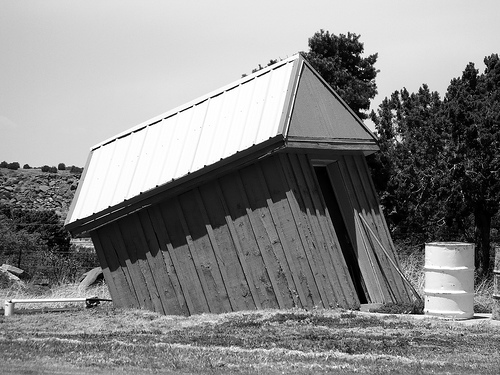
3.  Don’t worry your head about such petty issues as  structural integrity– it’s only a shed, right?

Photo by RogueSun Media via Flickr*


  ———————   

* Photo credits: “An extra room” by JaviC; “Entrance, Ufa/RU, 2009” by William Veerbeek; “Bad Construction P1000892” by RogueSun Media.  All via Flickr and made available via an Attribution-Noncommercial-ShareAlike 2.0 License.