Implied Warranties on Construction Projects

warrantyA contractor client asked me to explain to him what it meant when someone told him that he had given implied warranties to an owner.  This is an excellent question.

Implied warranties are warranties that the law presumes you have given to the other party.  Even if you never make any written warranty or guaranty, North Carolina courts will often find that you are still liable for certain warranties unless  you explicitly disclaim them.

The warranties that are generally implied in construction contracts include:

  • Warranty of Merchantability
  • Warranty of Fitness for a Particular Purpose
  • Warranty of Habitability (residential construction only)
  • Warranty of Plans and Specifications
  • Warranty of Workmanship
  • Warranty to not delay or hinder any other parties on the Project

What do these warranties mean?  Essentially, they all mean the same thing:  that your product or labor is at least acceptable.  It may not be perfect—but it meets certain minimum expectations.

Disclaimable Warranties

Warranty of Merchantability—Under the Uniform Commercial Code, this warranty states that the merchant or supplier of a  product delivered to the buyer warrant that the product is able to be used as intended.

Warranty of Fitness for a Particular Purpose—This warranty, also under the Uniform Commercial Code, states that a product will be able to be used for a specific purpose which the buyer has told you about.  It is usually less of an issue that merchantability—however, if a buyer tells you of an unusual need that he is expects the product you supply to him will meet, it can come into play.

Both of these warranties can be disclaimed—that is, you can assert that you are making no such warranties in your written contract or purchase order form.  Certain requirements apply to make a disclaimer valid, so check with legal counsel.

Nondisclaimable Warranties

The remaining warranties—Habitability, Plans and Specifications, Workmanship, and Not to Hinder or Delay—are warranties that, in general, cannot be disclaimed.

Warranty of Habitability– The contractor for new residential construction owes a duty to build a house (and related fixtures) such that it can be lived in for normal residential purposes.  This duty extends to both the original purchaser and subsequent purchasers, so long as statute of limitation and repose are met.

Warranty of Plans and Specifications–The owner impliedly warrants to the contractor that the plans and specifications provided to the contractor are adequate.  This is also called the “Spearin doctrine.”

Warranty of Workmanship—Every contractor impliedly warrants that his construction will be built in a workmanlike manner and sufficiently free of major defects.  This implied warranty is sometimes made express in written contracts—such as in AIA A201 3.5.1.

Warranty to Not Delay or Hinder—This warranty is owed by each contractor to his subcontractors, prime contractors to one another, and the owner to the contractor.

If a warranty is breached, the other party has a claim for breach of the implied warranty at issue.

  Question Mark Have a question about implied warranties?  Shoot me an email at mbrumback @rl-law dot com.

____________

Photo “Warranted/Day 70” by Aaron Goselin via Flikr made available via an Attribution-Noncommercial-Share Alike 3.0 License.

LEED Credibility Challenged– UPDATE

[This article was originally posted on June 10, 2010]

A group of local citizens, designers, and school board Building Committee members in Eagle Ridge, Wisconsin has issued a statement expressing their belief that LEED certifications are now suspect, following the failure of the USGBC to withdraw LEED Certification from the Northland Pines High School.  The group had appealed a decision to dismiss their claims that the LEED Gold certification for the school should be revoked, despite clear evidence which, they claim, shows that the building did not meet specific ASHRAE Standards, which are prerequisites to getting a LEED (green) building certification.

 They call into question the value of LEED certification if there is no verification of a purported building’s “green” credentials.

 You can download their statement of concern “USGBC and LEED Credibility Destroyed”.

  As previously mentioned on this blog, there is no clear idea of how the Courts would treat any LEED-specific claims.  Yet.  Stay tuned.

 UPDATE:  This afternoon, the USGBC has issued a statement standing by their findings:

LEED’s intent, and USGBC’s mission, is about helping people learn about and understand how to design, build and operate better buildings.  Buildings are complex systems of systems and any of the 100,000 of decisions associated with design, construction and operation can always be second-guessed. We are confident that our due diligence has been more than sufficient to put these issues to rest, and we are moving forward to focus our efforts where they do the most good — advancing the market uptake of green buildings and communities that is at the heart of our work

The full statement and commentary can be reviewed at Chris Cheatam’s article “Breaking: USGBC Stands by Its LEED Challenge Decision.”

How to Smartly Handle Project Documents

mountain of construction paperwork

Paperwork by luxomedia via Flickr

In the Contract Risks Management Group on LinkedIn, L.H. Chin wrote an article about file keeping for contract risk management.  Basically, his premise is that if you cannot keep your Project files orderly, you have exponentially increased your chances of a problem later.   His particular example dealt with originals versus reproduced copies, which is only somewhat germane to North Carolina contracts.  (Here, copies can be used as evidence most of the time—though not always).  His main point, however, about the ability to minimize future risks by having good document control policies in place, is something every project manager should think about.

 Here are a few tips of my own in that regard:

1.   File all communications in one place.  Don’t keep faxes in one file, email in another, and letters in a third.  Don’t keep incoming and outgoing correspondence separated by vendor.  Keep it all in one chronological file.  If you ever find yourself needing legal assistance, this will save many hours and untold stress for everybody.

1.b.  Caveat:  don’t feel like you need to print out every email.  Do, however, maintain a separate email e-folder for the Project, and go ahead and print those really crucial, smoking gun emails.

2.  If you insist on violating Rule 1 (and I know those of you who read this blog would never consider such a thing, right?):  Have all the files, categories, and such you want, but please also make a “master” chronological file of all correspondence.   Just do it.

3.  If you have any communications with your lawyer, an insurance representative (outside of the normal bonding paperwork), or otherwise have documents relating to potential claims, do keep them separate.  Put all such correspondence, in a folder marked “legal,” away from the Project file to prevent inadvertent disclosure to anyone else if there is ever litigation on the matter.

3.b  If in doubt whether something should be in “legal” or “correspondence”, err on the side of “legal.”  Your attorney can always change the classification later, but she can’t put the genie back in the bottle if something that is privileged is mistakenly given to a party suing you.

If you have any questions about these tips, or want to discuss your current procedure for record management, shoot me an email.  My contact information can be found on my Firm bio or at the Footer of the Blog.  Or, you can simply leave me a note in the comments. 
 

___________________________________

Photo: “Paperwork” by luxomedia via Flickr/CC license.

Need to caclulate 120 days from date of last furnishing for a notice of lien?

Just a quick resource note:

Photo by Andres Rueda via Flickr*


As anyone who has had the misfortune of sitting through the North Carolina General Contractor’s exam can tell you, there are two very important deadlines to keep in mind if you are not getting paid on a project– 120 days and 180 days.  These are dates associated with filing a Notice of Claim of Lien on Real Property  and Notice of Claim of Lien upon Funds, and the date associated with perfecting  a Claim of Lien with a Complaint.  Once these dates have passed, you may still sue to collect unpaid fees, but your statutory lien rights are lost (and with them, your most likely chance to get attorney fees). There is no room for error here.   One good site to bookmark is this online Date Calculator.  Use it to plug in the date of last furnishing to determine your notice and complaint deadlines.   For future reference, I have added a permanent link to this calculator to the “Resources” page.

 ___________

 Photo “ASIO fx-991MS SCIENTIFIC CALCULATOR” by Andres Rueda via Flickr and made available via an Attribution-Noncommercial-ShareAlike 2.0 License.  


Bad Construction Design– a lighthearted post

Construction don’ts:


2.  Don’t worry about how someone will actually reach the threshold to get into the building– that’s what step ladders are for!

Photo by William Veerbeek via Flickr*


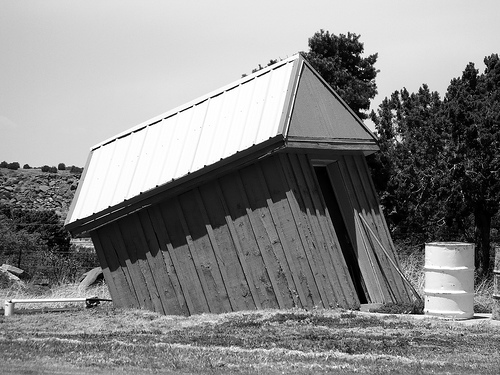
3.  Don’t worry your head about such petty issues as  structural integrity– it’s only a shed, right?

Photo by RogueSun Media via Flickr*


  ———————   

* Photo credits: “An extra room” by JaviC; “Entrance, Ufa/RU, 2009” by William Veerbeek; “Bad Construction P1000892” by RogueSun Media.  All via Flickr and made available via an Attribution-Noncommercial-ShareAlike 2.0 License.