Roof collapse investigations: Engineers Say Codes Adequate

snow collapses roof deck[This article was originally published on February 21, 2011.]

Following our story about green roofs, including one which collapsed under a weight of snow and ice, engineers speaking to the ENR have stated that Codes are adequate, but that they may need to be adjusted in certain situations:

[E]ngineer sources for this article say existing building codes are adequate if designers allow for a factor of safety. But Levy [Matthys Levy, chairman emeritus at Manhattan-based Weidlinger Associates]  recommends designers make proper allowances for snow accumulation such as when designing roof structures near parapet walls, especially those that are four feet or higher.

*  *  *

Multi-level roofs with steps instead of roof flashing can also be problematic with snow accumulation on a first-story portion, for instance, piling up against the second story, Levy says. “It’s best to avoid stepped designs unless you design for them,” he says. While an average of 40 psf may be adequate for designing most of a roof, designers should allow 60 psf to 80 psf for the parapet wall, he says. And mountainous regions may require twice as much strength, he says.

Garrick Goldenberg, professor of structural engineering at Wentworth Institute of Technology in Boston and chief structural engineer at Chappel Engineering Associates in Marlboro, Mass., said that while state building codes address snow drifts with requirements for the shape and slope of a roof, this year’s record snowfalls and ice accumulation with little thawing has led to a greater number of collapses.  In sampling snow at Chappel Engineering in early February, Goldenberg says his group found that even two feet of freshly fallen snow or more totaling 16 to 20 lb/sf was not a danger to buildings. On average, people assume fresh fallen snow produces eight pounds of pressure on a roof per square foot.

However, invisible loads caused by accumulation of ice have been a serious problem since ice weighs 7.5 to 8 times more per cu ft than snow. “In many cases, even before reaching two-foot snow loads, we were in excess of 30 pounds because of the ice,” he claims.

For more, go to the ENR full story: Ice, Snow Take Toll on Northeast Roofs, But Engineers Say Codes Are Adequat [note:  link no longer working when checked September 4, 2025].

What are your thoughts about current Codes, in light of the many collapses in the Northeast and Midwest?  Legally, does designing to Code, but failing to take into account likely weather events, make your design deficient?  I’ll post some of my thoughts in a subsequent post, but share yours below.

—————————-

 Photo: “Deck roof collapse”   by Derek K. Miller via Creative Commons license/Flickr

Can a designer limit his liability to his fees for service?

Architects and engineers (and the owners/contractors with whom they contract) often wonder whether limiting liability language is enforceable.  The answer, as in much of construction law, is very much dependent on what state’s court will be interpreting the contract.  Some states allow such limiting language, and others do not.

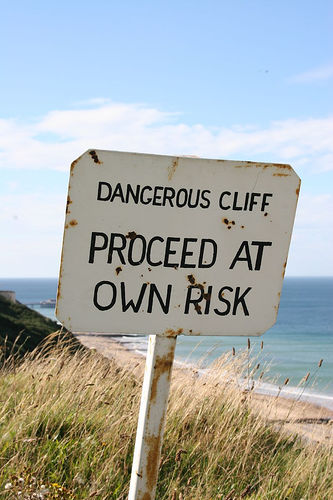
sign: proceed at own risk


In North Carolina, so long as the limitation of liability is not also an agreement to be liable for the other party’s negligence (which is barred as against public policy), such a limitation of liability is enforceable.  A case discussing this issue from the engineering perspective is Blaylock Grading Co., LLP v. Smith et al, 189 N.C. App. 508, 658 S.E.2d 680 (2008).  In that case, a surveying engineer limited his liability, via contract, to $50,000.  The Court, citing an earlier state Supreme Court decision, ruled that the limitation was valid and enforceable:

People should be entitled to contract on their own terms without the indulgence of paternalism by courts in the alleviation of one side or another from the effects of a bad bargain.  Also, they should be permitted to enter into contracts that actually may be unreasonable or which may lead to hardship on one side.  It is only where it turns out that one side or the other is to be penalized by the enforcement of the terms of a contract so unconscionable that no decent, fairminded person would view the ensuing result without being possessed of a profound sense of injustice, that equity will deny the use of its good offices in the enforcement of such unconscionability.  Id. at 511, 658 S.E.2d at 682.

Is this rule absolute?  Clearly not, as the above quote indicates.  Unconscionable limitations will not be enforced.  Moreover, a third party, not subject to the contractual terms, is free to sue in negligence.  But as between the contracting parties, such a limitation on damages can be a powerful tool to minimize exposure to risk.

Questions about limitations on liability?  Comment below or drop me a line.  And be sure to sign up for email delivery of blog posts directly to your inbox.

 ————————

Photo:  “Proceed at own risk” by Dave Nicoll via Flickr/Creative Commons license 

Why should a Designer worry about the Contractor’s insurance issues?

Insurance: not just for Geckos anymore

You may wonder why you, as the designer of record, should care about the insurance coverage of the contractor on your construction projects.  After all, that is an issue between the contractor and the owner, right?  Not so fast.  Recent court cases addressing whether or not commercial general liability (CGL) policies provide insurance coverage for a contractor’s poor workmanship can create problems for architects and engineers.

Since architects and engineers usually have errors & omissions policies (and you do have E&O coverage, right?), they may be the only ones with “deep pockets” should litigation arise over construction defects.   The take-away?  It *is* your business to make sure that the contractors on your projects have sufficient resources to pay for construction defects.  It is also in your best financial interest to ensure that you are only working with top-notch, quality contractors. 

The insurance folks at Victor O. Schinnerer & Company recommend:

More than ever, design professionals should use sound risk management practices when selecting new projects—especially condo projects. Design professionals should insist upon providing full construction phase services and should urge developers to retain contractors using qualifications-based selection procedures. 

I wholeheartedly concur.

Questions?  comments on how Builder CGL policy issues are relevant to your design risks?  Drop me a line.

————————–

Photo: “Geico Gecko”  by Scott Kinmartin via Flickr/Creative Commons License.

Insurance Physical: worth the check up!

check up

An insurance “check up” can keep your business fit & healthy

Recently I was contacted by a blog reader– let’s call him Mark–  who suggested that I write a post on reviewing insurance policies. “Mark” shared a personal story in which, even though he had incorporated his business, he was sued personally under a “piercing the corporate veil” theory.  Essentially, the plaintiff was trying to get at his personal assets.  After reporting the claim to his insurance agent, he discovered he may not have had sufficient insurance coverage.  He did not have a D&O policy, which can provide protection for a corporation’s directors and officers.

Contrary to insurance being just another item to scratch off your list, take some time to review your insurance policies and see if you have the coverage you think you have, and if there are other coverages which you might need but have not yet obtained.  In addition to D&O policies, there are E&O (errors & omissions) policies for design professionals, CGL (commercial general liability) policies, builders’ risk policies, workers’ compensation policies, and umbrella policies, to name a few.  The language and endorsements in your particular policy are important, and it is worth taking time (perhaps annually) for an overall insurance-health checkup.

You should make sure that your insurance agent knows your business and the possible risks.  An insurance agent that specializes in your type of business is your best bet to ensure that you obtain and maintain full coverage.  In addition, it is a good idea to have your policies reviewed by your construction attorney, so you can learn exactly what is—and what is not—covered.

Next week (on Wednesday), we will have a guest post on how indemnity language in your contracts can limit (or eliminate) your insurance coverage.  Stay tuned.

In the meantime, questions or comments about insurance for construction and design professionals?  Join the conversation in the comment section, below. 

Photo Courtesy of U.S. Army. 

wind turbine

NC Green Contractors & Professionals Directory (Tue Tip)

wind turbineUpdate 3/9/2017: The NC Solar Center is now the NC Clean Energy Technology Center.  When last visited, the Professional Directory was no longer active.

Considering a Renewable Energy project?  Professional who specializes in green construction?  Either way, check out the North Carolina Green Professional Directory, published (with disclaimers) by the NC Solar Center.  The directory is searchable by professional type, by green technology, and by location, and professionals who qualify can apply to be added to the directory.

——————-

Photo from NC Solar Center