The top 10 architecture mistakes of the 21st century (guest post)

For a fun Friday guest post, Marcela De Vivo is joining us today.  Marcela is a freelance writer from Los Angeles, focusing on Marketing, Real Estate, and Technology.  She works for Process Sensors Intl and spends her time connecting online, reading and researching. 
 —————
The 21st century is one of the most innovative eras for architecture. With great ideas, there comes great failures.
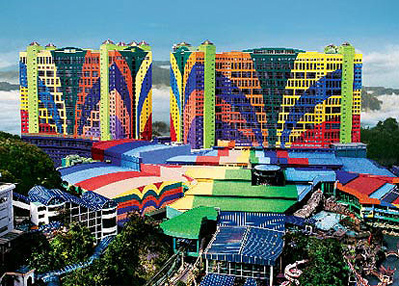
Starting at number ten is the First World Hotel from Malaysia. It was once, the biggest hotel in the world, but it fell short in terms of design. The main problem came with the color scheme. It looks as if the designer had an obsession with rainbows.
—————
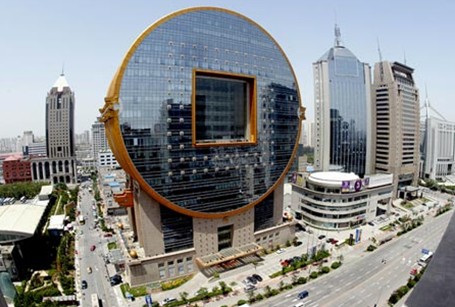
Number nine goes to a building that looks great as something in your pocket, but not as an architectural inspiration. It resembles an old Chinese currency that is circular with a square cutout in the middle. The building, known as the Fang Yuan building, is in Shenyang, China.
—————

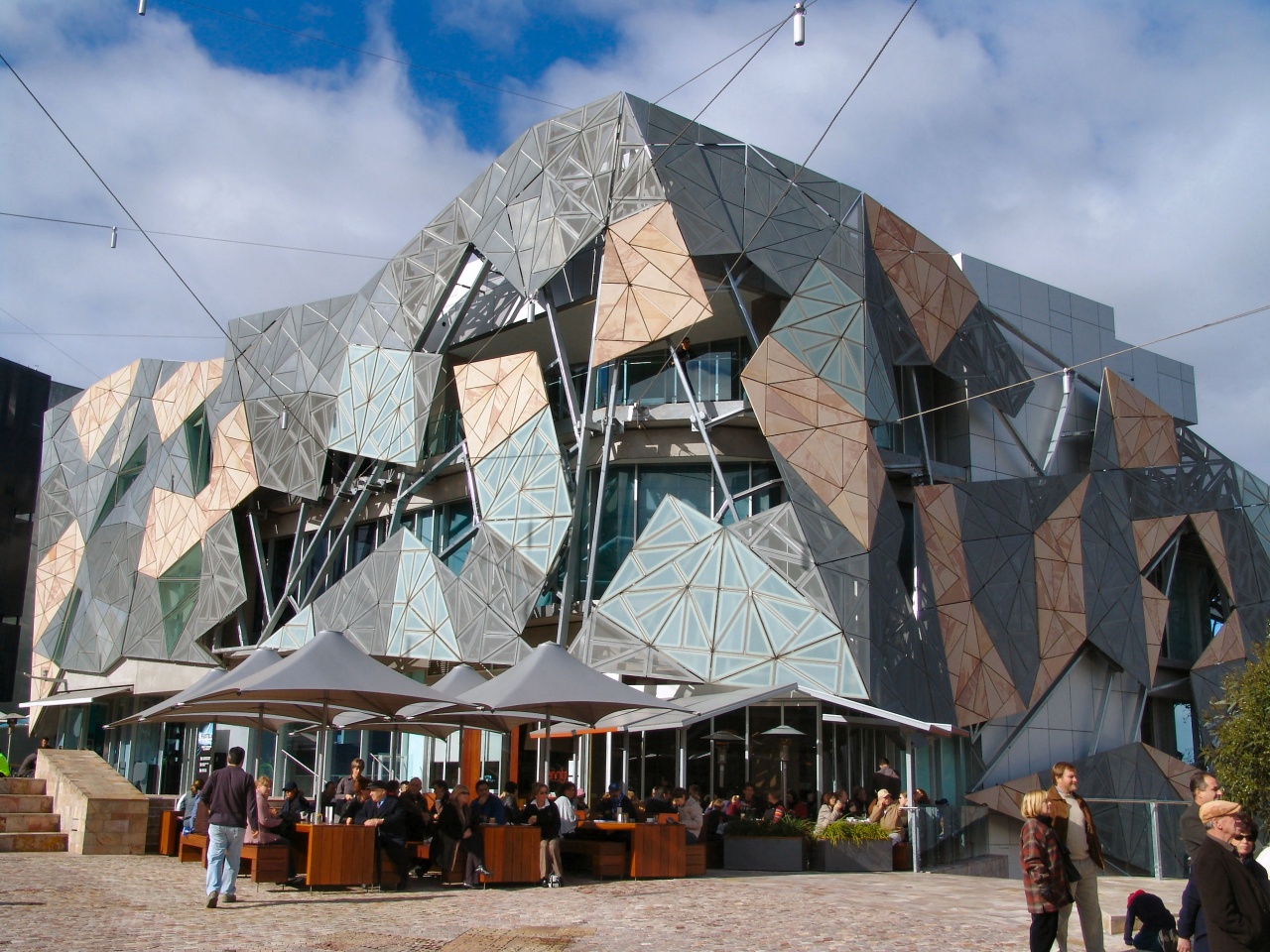
Eight is the Federation Square in Melbourne, Australia. It contains many buildings that seems incomplete. Patched by a bunch of metal plates with various patterns, the square is lacking a wholesome building.
—————
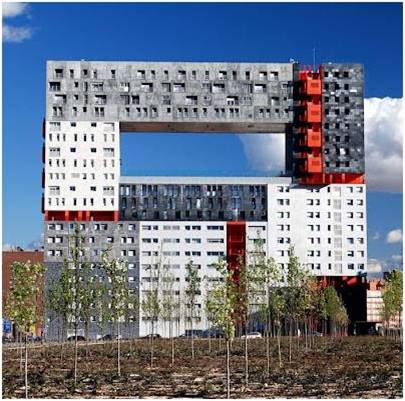
Lucky number seven was created through the collaboration of Dutch architecture studio MVRDV and Spanish architect Blanca Lleo. The result was not so great. Assuming they were going for a abstract look, it came off as random and bland. It contains random streaks of red lines in obscure areas.
—————
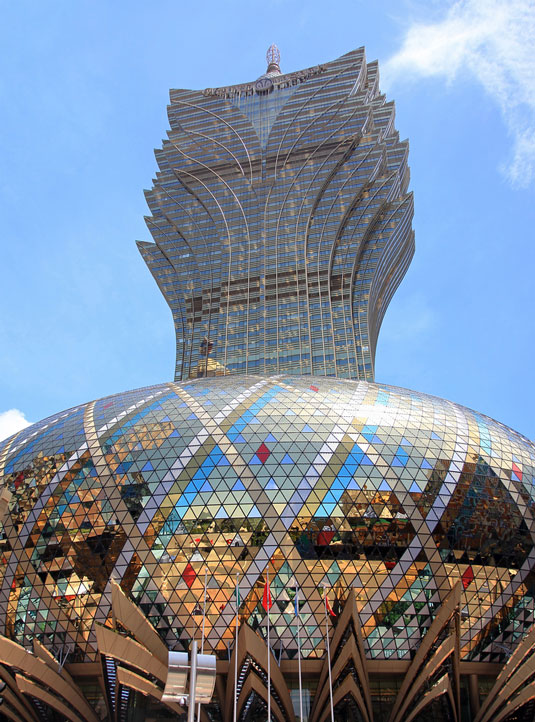
Six is a shiny pineapple shaped building in Macau. It is a hotel and a casino with 430 rooms and over 800 table games. It is also the home to the “star of Stanley Ho”, the world’s largest cushion shaped internally flawless D-color diamond.
—————
At number five, the National Library of Belarus opened in 2006 in Minsk. The shape is reminded of a virus. It houses the largest collection of Belarusian printed materials and has the third largest collection of Russian books.

 —————

 Number four is similar to the Fang Yuan building because of its circular structure. The Aldar headquarters located in Dubai has the shape and color of a fly’s eye.

—————
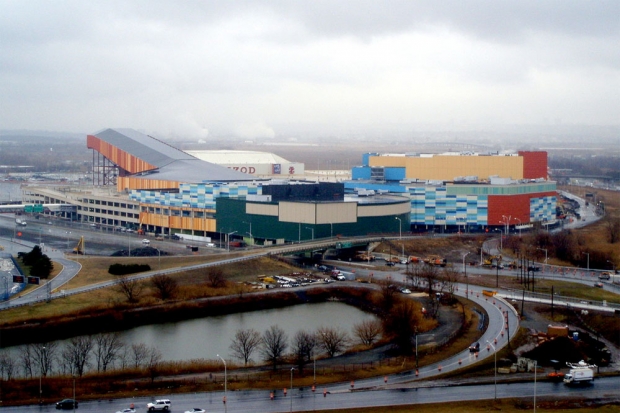
Number three is the Meadowlands Xanadu that is to be finished by 2013. It is located in New Jersey. Even the governor is saying bad things about the project.
 —————
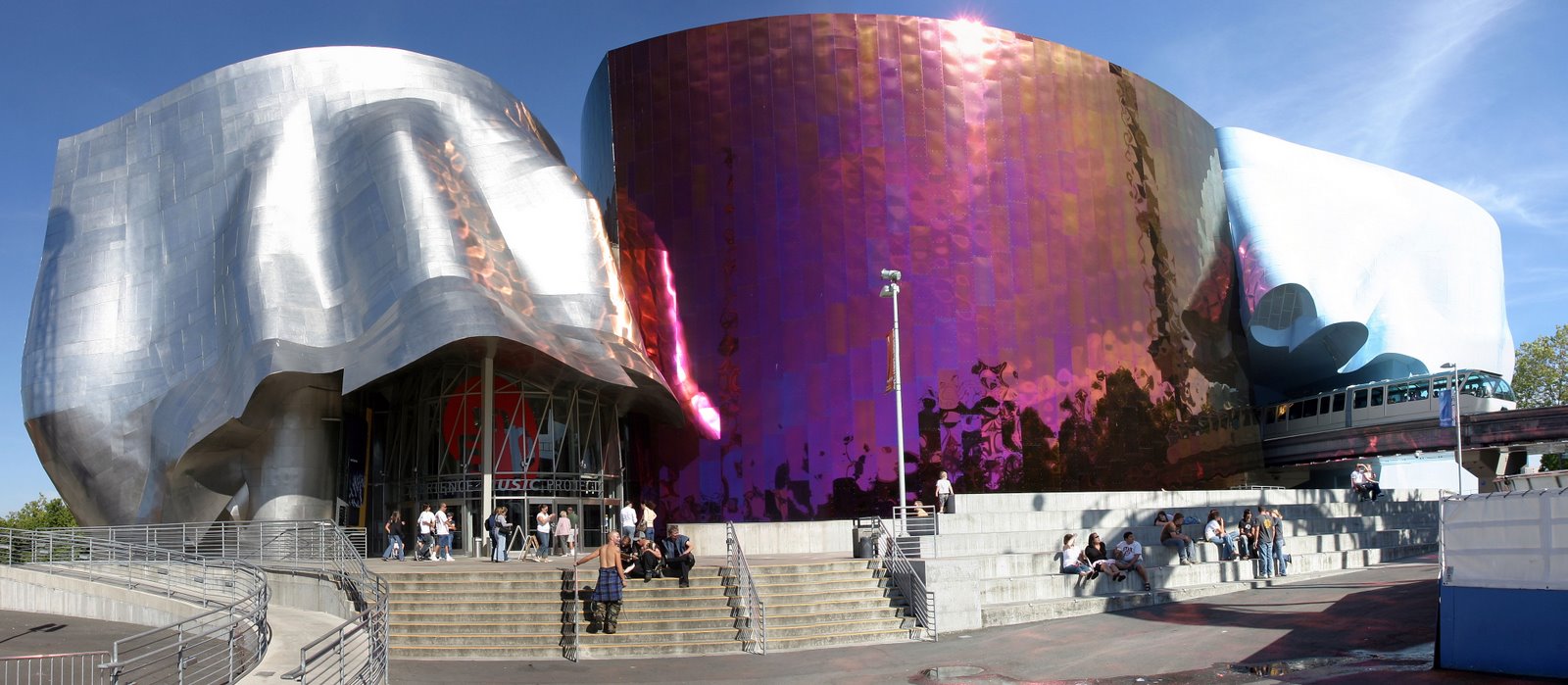
Number two goes to the EMP Museum for being just plain random and hideous.
—————
Number one, the worst architecture made to this date, is none other than the latest observation tower of the 2012 London Olympics, the ArcelorMittal Orbit sculpture and observation tower. It is like an entanglement of wires construed together by an even gray spiral.



—————

This concludes my list of the top ten architecture mistakes of the 21st century. You really have to wonder what the architects were thinking when they created these buildings.  All we can do is hope others won’t follow suit.
Do you concur? Object? Have other nominations?  Let us know in the comment section, below.

Play Nicely in the Sandbox (or, Why GC’s and Subs Should Get Along) (guest post)

Chris HillToday’s guest post is from Christopher G. Hill, lawyer, Virginia Supreme Court certified General District Court mediator and owner of the Richmond, VA firm, The Law Office of Christopher G. Hill, PC, a LEED AP. Chris authors the Construction Law Musings blog where he discusses legal and policy issues relevant to construction professionals. Additionally, Chris is active in the Associated General Contractors of Virginia and a member of the Board of Governors for the Construction Law and Public Contracts Section of the Virginia State Bar.

———
First off, thanks to Melissa for this opportunity to post here at Construction Law in North Carolina. Having co-presented with her and discussed construction contracting from all perspectives, I can safely say she’s good at what she does and shares great insight here at her blog.

Now that the formalities are out of the way, I thought I’d share my thoughts as one who represents many subcontractors and general contractors on the topic of good relationships meaning good business. I am always a bit surprised at the failure of either side of the GC/Sub dynamic to act in a businesslike manner.

Remember, the General Contractor and the subs are in the boat together in many ways. They both have a job to do and, ultimately, an owner at the top of the payment food chain that is looking to get a project done on time. Ultimately, they both have an architect/engineer representing the owner that may or may not be up on the job (sorry Melissa) and may not be trained in project management. If the general and its subs aren’t “playing well in the sandbox” together, the relationships up and down the project chain get all out of whack and cause delays in completion and importantly in payment.

Another phenomenon that happens more frequently than I would like is the general contractor “burning” good subcontractors in an area through making payment (particularly final payment) difficult to receive. While this type of activity occurs on what I am sure is the minority of projects (and fully acknowledging that my practice makes me think that Murphy was an optimist) I am always flabbergasted by this sort of treatment given to a subcontractor that should be helping pull the boat.

While it is obvious that subs need to play nice with GC’s because they have the money, it may seem less obvious how the above can hurt a general contractor. The short answer (and don’t worry I won’t be going into the long one) is that burning good subs eventually means that good subs won’t work with you. Subs talk to each other. Your reputation will precede you. Eventually the economy will improve and you won’t be the only game in town. Not to mention that such actions are the stuff of which claims are made.

In short, getting along costs your local construction lawyer money because he or she doesn’t get to go to court for you. It is almost always less expensive to get along, finish the job and work out payment than to get we attorneys involved in the construction claims process.

To make a long story somewhat less long, GC’s work with the subs and subs, play nice with the GC’s. It’s the best way to a lower stress project and a higher monetary payoff.

Thanks, Chris, for your insights from the contractor’s side of things.  Even if you did (politely) slam the hard-working design professionals.  Reader, now it’s your turn.  Share your thoughts, comments, or questions with Chris or me in the comment section, below.

Latent Defects: extending the statute of limitations (law note)

defective-tools-cause-injuriesAs we’ve previously discussed, the statute of limitations for construction claims in North Carolina is generally three years.  That is, once 3 years have passed, you are generally protected from any lawsuit filed after that time.

Does that mean that no lawsuit can be filed against you subsequent to that time?  No.  First, the statute of limitations is an affirmative defense, meaning that you must timely assert the defense as part of your response to the lawsuit.

Secondly, it is sometimes not apparent when the three year period begins to run.  Substantial completion or final completion?  What if your work is finished, but the project is not– does the three year period not start until project completion?  The issue of whether the statute of limitations has run is complex, and a mixture of law and fact questions.  See, Lord et al v. Customized Consulting Specialty, Inc. et al, 182 N.C. App. 635, 643 S.E.2d 28 (2007).

Finally, be aware of the hidden danger of hidden dangers. 

The three years does not start to run until it becomes obvious that there is damage stemming from your professional negligence.  The applicable statute states that the three years “shall not accrue until bodily harm to the claimant or physical damage to his property becomes apparent or ought reasonably to have become apparent to the claimant, whichever event first occurs.” N.C. Gen.Stat. § 1-52 (2005).

In other words, if there is a defect that is not readily observable and visual, the three years may not start to run until it becomes observable (e.g., through destructive testing, repair work, or renovation work).  This is what is known as a “latent defect”, and it can impose liability far beyond the initial 3 years.

Does the latent defect rule extend liability indefinitely?  No, it does not.  The statute of repose (6 years in NC; other states vary) will impose an absolute final date on real property improvements, after which no further liability can successfully be claimed.

Questions?  Drop me a comment, below.  Also, be sure to sign up for regular email updates and our free Construction Professional newsletter by entering your contact information on the top right of the homepage.

Photo “Defective Tools Cause Injuries” – NARA – 514107 

Architects & Engineers – Are you committing a Class 2 misdemeanor without realizing it? (Tue Tip; law note)

handcuffsBuried within the general contractor provisions of the North Carolina General Statutes is a little-known provision that can get architects and engineers in hot water.  If you recommend to a project owner anyone who is not properly licensed under the general contractor statute, you have committed a Class 2 misdemeanor.  Really!  Here is the pertinent language:

§ 87-13. Unauthorized practice of contracting; impersonating contractor; false certificate; giving false evidence to Board; penalties

Any person, firm, or corporation not being duly authorized who shall contract for or bid upon the construction of any of the projects or works enumerated in G.S. 87-1, without having first complied with the provisions hereof, or who shall attempt to practice general contracting in the State, except as provided for in this Article, and any person, firm, or corporation presenting or attempting to file as his own the licensed certificate of another or who shall give false or forged evidence of any kind to the Board or to any member thereof in maintaining a certificate of license or who falsely shall impersonate another or who shall use an expired or revoked certificate of license, and any architect or engineer who recommends to any project owner the award of a contract to anyone not properly licensed under this Article, shall be deemed guilty of a Class 2 misdemeanor. And the Board may, in its discretion, use its funds to defray the expense, legal or otherwise, in the prosecution of any violations of this Article.

However, there is also some relief in the same statute, which provides that:

No architect or engineer shall be guilty of a violation of this section if his recommendation to award a contract is made in reliance upon current written information received by him from the appropriate Contractor Licensing Board of this State which information erroneously indicates that the contractor being recommended for contract award is properly licensed.

Has this issue ever really been litigated?  Yes, it has.  While I cannot point to reported cases, I will tell you that I have had this become an issue – more than once – in my practice.  Each time, the design professional knew that the entity involved had been a licensed general contractor, but the entity had lost its contractor’s license before the particular project at issue.

Take-away:  Even if the general contractor is the largest and most well-known in the state, always, always, always check with the Licensing Board to confirm that a general contractor is in good standing before making any recommendation to a project owner.  Just in case.  Since Consider it two minutes well spent.

Questions, comments, experiences with this statute?  Share in the comments section of the blog.

Photo (c) Riki Maltese via CC


Something to Hang Your Hat On… (Limitation of Liability clauses) (law note)

hat rackIn the past on this blog, I have pointed out the benefits of Limitations of Liability clauses.  These are the clauses that state that the most damages that your Firm can be responsible for is capped at a certain dollar amount or your contracted fee.

Do you have a limitations of liability clause in your professional services contract?  You should.  Best practice would be to have such a clause that limits damages against you to a set amount.  For example:

Engineer’s liability to Client for any and all injuries, claims, losses, expenses, damages or claim expenses arising out of this agreement, from any cause or causes, shall not exceed the total amount of $50,000 or the amount of Engineer’s fee, whichever is greater.

While best practice is to have such a provision, it is not always enforced.  In a case arising out of the Western District of North Carolina, the court noted that such provisions will not be enforced where the result would be unconscionable and “elicit a profound sense of injustice.” See  Performance Sales & Mktg., LLC v. Lowe’s Companies, Inc.,2010 WL 2294323 (W.D.N.C. June 4, 2010).

What does this mean in practical terms?  It means that you should endeavor to include a limitation of liability clause, but don’t necessarily think that if you have that you’ve capped your risk.  A court can always decide that the clause is unconscionable.  But, such a limitation is one more thing to “hang your hat on” if and when you find yourself staring down the barrel of litigation*.

* If, however, you are facing litigation, make sure you sign up for regular blog updates.  Starting next week, I am writing a new series on the anatomy of a construction lawsuit, so stick around! 


Photo:  (c) BabbNet via CC.