
“Don’t” by Danielle Scott via Flickr
____________________
“Don’t” by Danielle Scott via Flickr/CC license.
“Don’t” by Danielle Scott via Flickr
____________________
“Don’t” by Danielle Scott via Flickr/CC license.

Paperwork by luxomedia via Flickr
In the Contract Risks Management Group on LinkedIn, L.H. Chin wrote an article about file keeping for contract risk management. Basically, his premise is that if you cannot keep your Project files orderly, you have exponentially increased your chances of a problem later. His particular example dealt with originals versus reproduced copies, which is only somewhat germane to North Carolina contracts. (Here, copies can be used as evidence most of the time—though not always). His main point, however, about the ability to minimize future risks by having good document control policies in place, is something every project manager should think about.
Here are a few tips of my own in that regard:
1. File all communications in one place. Don’t keep faxes in one file, email in another, and letters in a third. Don’t keep incoming and outgoing correspondence separated by vendor. Keep it all in one chronological file. If you ever find yourself needing legal assistance, this will save many hours and untold stress for everybody.
1.b. Caveat: don’t feel like you need to print out every email. Do, however, maintain a separate email e-folder for the Project, and go ahead and print those really crucial, smoking gun emails.
2. If you insist on violating Rule 1 (and I know those of you who read this blog would never consider such a thing, right?): Have all the files, categories, and such you want, but please also make a “master” chronological file of all correspondence. Just do it.
3. If you have any communications with your lawyer, an insurance representative (outside of the normal bonding paperwork), or otherwise have documents relating to potential claims, do keep them separate. Put all such correspondence, in a folder marked “legal,” away from the Project file to prevent inadvertent disclosure to anyone else if there is ever litigation on the matter.
3.b If in doubt whether something should be in “legal” or “correspondence”, err on the side of “legal.” Your attorney can always change the classification later, but she can’t put the genie back in the bottle if something that is privileged is mistakenly given to a party suing you.
If you have any questions about these tips, or want to discuss your current procedure for record management, shoot me an email. My contact information can be found on my Firm bio or at the Footer of the Blog. Or, you can simply leave me a note in the comments.___________________________________
Photo: “Paperwork” by luxomedia via Flickr/CC license.

Photo by Andres Rueda via Flickr*
As anyone who has had the misfortune of sitting through the North Carolina General Contractor’s exam can tell you, there are two very important deadlines to keep in mind if you are not getting paid on a project– 120 days and 180 days. These are dates associated with filing a Notice of Claim of Lien on Real Property and Notice of Claim of Lien upon Funds, and the date associated with perfecting a Claim of Lien with a Complaint. Once these dates have passed, you may still sue to collect unpaid fees, but your statutory lien rights are lost (and with them, your most likely chance to get attorney fees). There is no room for error here. One good site to bookmark is this online Date Calculator. Use it to plug in the date of last furnishing to determine your notice and complaint deadlines. For future reference, I have added a permanent link to this calculator to the “Resources” page.
___________
Photo “ASIO fx-991MS SCIENTIFIC CALCULATOR” by Andres Rueda via Flickr and made available via an Attribution-Noncommercial-ShareAlike 2.0 License.

2. Don’t worry about how someone will actually reach the threshold to get into the building– that’s what step ladders are for!

Photo by William Veerbeek via Flickr*
3. Don’t worry your head about such petty issues as structural integrity– it’s only a shed, right?
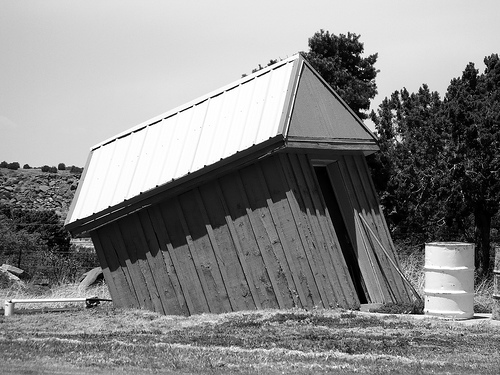
Photo by RogueSun Media via Flickr*
———————
* Photo credits: “An extra room” by JaviC; “Entrance, Ufa/RU, 2009” by William Veerbeek; “Bad Construction P1000892” by RogueSun Media. All via Flickr and made available via an Attribution-Noncommercial-ShareAlike 2.0 License.
 The answer, as is always the answer when you ask an attorney a question, is “it depends.” Lawyers don’t say “it depends” just to drive clients mad—really, we don’t. The thing is, lawyers, by their very nature, are cautious.
Lawyers want to plan for all situations and possibilities. Likewise, a construction contract can become an unwieldy document that only a lawyer could love, as it provides for all conceivable areas of dispute and all possible contingent situations. Such a contract does no one much good.
The best contract for you is the contract that is appropriate for your construction project and the players in that project. If the project is a multi-million dollar, multi-year project, you probably should not skimp on having a well-crafted, attorney-vetted contract specific to your deal. If, on the other hand, the project is a one-day residential job, you can get by on much less.
Do not assume, however, that just because a contract is small in terms of dollars or man-hours that you do not need a contract. You do. (See my earlier post on the importance of a written contract.) Paradoxically, some of the most hotly contested lawsuits involve homeowners. After all, their home is their castle.
In fact, a house is usually the single largest investment decision that most people will ever make, often involving a mortgage that may take as many as 30 years to pay off. It is only natural, therefore, that homeowners will be extra exacting when it comes to issues relating to their home.
To go back to the original question—how much contract you need depends very much on the situation. A two page, simple contract may be sufficient for your purposes, if it is carefully crafted to account for all common areas of dispute which may arise. It is vital, however, that you have one, and that it is in writing.
Photo (c) Open Clip Art