Can a designer limit his liability to his fees for service?

Architects and engineers (and the owners/contractors with whom they contract) often wonder whether limiting liability language is enforceable.  The answer, as in much of construction law, is very much dependent on what state’s court will be interpreting the contract.  Some states allow such limiting language, and others do not.

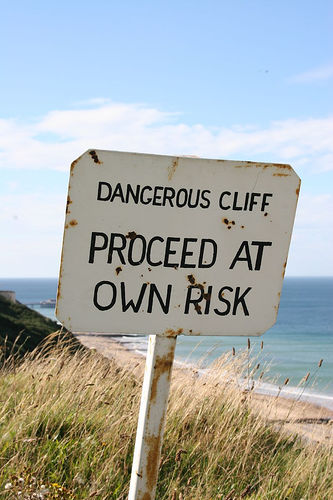
sign: proceed at own risk


In North Carolina, so long as the limitation of liability is not also an agreement to be liable for the other party’s negligence (which is barred as against public policy), such a limitation of liability is enforceable.  A case discussing this issue from the engineering perspective is Blaylock Grading Co., LLP v. Smith et al, 189 N.C. App. 508, 658 S.E.2d 680 (2008).  In that case, a surveying engineer limited his liability, via contract, to $50,000.  The Court, citing an earlier state Supreme Court decision, ruled that the limitation was valid and enforceable:

People should be entitled to contract on their own terms without the indulgence of paternalism by courts in the alleviation of one side or another from the effects of a bad bargain.  Also, they should be permitted to enter into contracts that actually may be unreasonable or which may lead to hardship on one side.  It is only where it turns out that one side or the other is to be penalized by the enforcement of the terms of a contract so unconscionable that no decent, fairminded person would view the ensuing result without being possessed of a profound sense of injustice, that equity will deny the use of its good offices in the enforcement of such unconscionability.  Id. at 511, 658 S.E.2d at 682.

Is this rule absolute?  Clearly not, as the above quote indicates.  Unconscionable limitations will not be enforced.  Moreover, a third party, not subject to the contractual terms, is free to sue in negligence.  But as between the contracting parties, such a limitation on damages can be a powerful tool to minimize exposure to risk.

Questions about limitations on liability?  Comment below or drop me a line.  And be sure to sign up for email delivery of blog posts directly to your inbox.

 ————————

Photo:  “Proceed at own risk” by Dave Nicoll via Flickr/Creative Commons license 

Why should a Designer worry about the Contractor’s insurance issues?

Insurance: not just for Geckos anymore

You may wonder why you, as the designer of record, should care about the insurance coverage of the contractor on your construction projects.  After all, that is an issue between the contractor and the owner, right?  Not so fast.  Recent court cases addressing whether or not commercial general liability (CGL) policies provide insurance coverage for a contractor’s poor workmanship can create problems for architects and engineers.

Since architects and engineers usually have errors & omissions policies (and you do have E&O coverage, right?), they may be the only ones with “deep pockets” should litigation arise over construction defects.   The take-away?  It *is* your business to make sure that the contractors on your projects have sufficient resources to pay for construction defects.  It is also in your best financial interest to ensure that you are only working with top-notch, quality contractors. 

The insurance folks at Victor O. Schinnerer & Company recommend:

More than ever, design professionals should use sound risk management practices when selecting new projects—especially condo projects. Design professionals should insist upon providing full construction phase services and should urge developers to retain contractors using qualifications-based selection procedures. 

I wholeheartedly concur.

Questions?  comments on how Builder CGL policy issues are relevant to your design risks?  Drop me a line.

————————–

Photo: “Geico Gecko”  by Scott Kinmartin via Flickr/Creative Commons License.

Root canals & Lawsuits: two things to avoid (Law Note)

man flossing

No one (with the exception of sadistic dentists)  likes root canals, and no one (except lawyers) likes lawsuits.  In the same way you can prevent (or limit) the need for root canals through proper flossing habits, you can limit the number of lawsuits you need to be involved in if you include everyone you should the first time around.  For those involved in filing construction liens, this means that when you perfect a lien by filing the lawsuit, be sure you include everyone you need to include.  A recent North Carolina Court of Appeals case demonstrates this principle in full living color.

In Lawyers Title Insurance Corp. v. Zogreo, LLC, __ N.C. App. __ (November 16, 2010), two contractors filed and perfected valid liens on a piece of property.  They did not include, in the lawsuits to perfect the liens, the banks which had given funds to the property owner after they first began work on the property.  The Court held that it was entirely proper not to include the banks (who held deeds of trust on the property to secure their loans); however, by the contractors’ failure to include them, they were forced to later litigate priority issues with the banks.  This is because “if a subsequent encumbrancer is not joined [in the underlying lien perfection lawsuit], he is not bound by the judgment in the action between the contractor and the owner.”

In other words, even though they filed proper liens, filed the lawsuits timely, and even won final judgment in those lawsuits, because they did not include the banks, the banks were free to start a new action, which they did in this case.  The banks also obtained an injunction to stop any judicial sale of the property until priorities could be established.

Moral of the story? It is better to include all subsequent encumbrancers (i.e., the banks) when perfecting a lien.  It’s not required, but it is better practice.  (And flossing your teeth isn’t required, either).   After all, who wants a root canal, or, in this case, to re-litigate your right to be paid money in yet another expensive lawsuit?  When it comes to root canals and lawsuits, fewer is better.

Sign up for email delivery of all blog posts directly to your email through the subscription box on the front page of the website.

——————-

Photo: Day One Hundred Fifty-One by Eric Mesa via Flickr/Creative Commons License

wind turbine

NC Green Contractors & Professionals Directory (Tue Tip)

wind turbineUpdate 3/9/2017: The NC Solar Center is now the NC Clean Energy Technology Center.  When last visited, the Professional Directory was no longer active.

Considering a Renewable Energy project?  Professional who specializes in green construction?  Either way, check out the North Carolina Green Professional Directory, published (with disclaimers) by the NC Solar Center.  The directory is searchable by professional type, by green technology, and by location, and professionals who qualify can apply to be added to the directory.

——————-

Photo from NC Solar Center

Active vs. Passive Negligence (Law note)

whole hog sign“As long as I was in, and in for good, I might as well go the whole hog.”

–Huck Finn, The Adventures of Huckleberry Finn by Mark Twain

————————-

If you work on a North Carolina construction project, you, too, are in “the whole hog” if you are negligent.  That is, if you are negligent at all, you are on the hook for the full lot.  As we’ve discussed, joint tort-feasors (that is, two negligent parties who are jointly & severally liable) are generally not entitled to indemnity from one another.

However, there are exceptions, and today we’re talking about one such exception– the passively negligent party.  

What is passive negligence?

Active negligence is an action which causes damage.  In contrast, passive negligence is negligence due to inaction, omission, or the failure to do something that you are legally obligated to do.   The actively negligent party is primary responsible for paying any damages, and the passively negligent party is only secondarily liable.

For example, if a subcontractor is actively negligent in constructing the framing for a building, and the general contractor failed to notice the defect, the subcontractor is actively negligent and the general contractor is passively negligent. 

Indemnity of the passively negligent party

Where the active negligence of one tort-feasor and the passive negligence of another combine to proximately cause injury to a third party, the passively negligent tort-feasor who is compelled to pay damages to the injured party is entitled to indemnity from the actively negligent tort-feasor.  This is called common-law indemnity, as opposed to contractual indemnity, which we discussed in an earlier blog post. 

In our example above, the subcontractor, as the actively negligent party, is the party ultimately responsible for the poor framing and the resulting damages.  If the general contractor is sued by the owner, he can in turn sue the subcontractor for the damages which were caused by the sub.

Questions about active versus passive negligence?  Drop me a line in the comments below.

—————————-

Photo “Whole Hog Heaven BBQ” by Bill.Roehl via Flickr/Creative Commons license.