Engineering flaws cited in Oil Spill Report

Horizon explosion

The Chief Counsel’s Report on the BP Deepwater Horizon Oil Spill and Offshore Drilling has been released.  Following on the heals of the January National  Commission report to the President, the Chief Counsel’s report “provides damning evidence that preventable engineering and management mistakes—rather than mechanical failings—were the primary cause of the Deepwater Horizon rig explosion last spring,” notes ENR’s Pam Hunter.

Among the Technical Findings, the Report states that the root cause of the failure was that the cement that BP and Halliburton pumped to the bottom of the well did not seal off hydrocarbons in the formation.  The report acknowledges several factors which may have increased the risk of cement failure, including:

  • drilling complications forced engineers to plan a finesse  cement job that called for, among other things, a low overall volume of cement.
  • the cement slurry itself was poorly designed—some of Halliburton‘s own internal tests showed that the design was unstable, and subsequent testing by the Chief Counsel‘s team raised further concerns.
  • BP‘s temporary abandonment procedures—finalized only at the last minute—called for rig personnel to severely underbalance the well before installing any additional barriers to back up the cement job.

Among the Management Findings, the Report states:

  • BP did not adequately identify or address risks created by last-minute changes to well design and procedures. BP changed its plans repeatedly and up to the very last minute, sometimes causing confusion and frustration among BP employees and rig personnel.
  • Halliburton appears to have done little to supervise the work of its key cementing personnel and does not appear to have meaningfully reviewed data that should have prompted it to redesign the Macondo cement slurry.
  • Transocean did not adequately train its employees in emergency procedures and kick detection, and did not inform them of crucial lessons learned from a similar and recent near-miss drilling incident.

Legal Status?  The lawsuits that will be flowing (pardon the pun) from this disaster will be extreme.  Expect to see possible class action certifications requested for some of those that were suffered damages.  In any lawsuit related to the spill, the report by the Chief Counsel will, undoubtedly, be Exhibit A.

——————————–

Photo credit:  Richard Sullivan, via Wikimedia/Creative Commons license.

Engineering Firms in the Cross-hairs

[note: this article was originally posted February 11, 2011]

Two national engineering companies are in the cross-hairs of the Delaware Department of Transportation.

The Delaware Department of Transportation (DelDOT) has filed suit against Florida-based Figg Bridge Engineers and its subcontractor, Atlanta-based Mactec Engineering, for alleged geotechnical engineering errors involved in a failed effort to build a new bridge over the Indian River Inlet in Sussex County, Delaware.   According to a Press Release issued by the State of Delaware, as embankment construction was nearing completion in early 2007, excessive settlement, bulging, tilting and other deformation of the embankment walls were observed. After investigation, DelDOT concluded that the embankments would pose continual and costly maintenance, as well as construction and safety risks and should be replaced with elevated roadway approaches to the new bridge. The Federal Highway Administration, which is providing a large portion of the funding for the replacement bridge, agreed with DelDOT’s conclusion to remove the embankments.
DelDot bridge

The lawsuit states that the deficiencies in the embankments are directly attributable to the failures and omissions of MACTEC, and that MACTEC, as sub-consultant to Figg, breached the standard of care that it owed to DelDOT. The facts in the complaint  “are based upon comprehensive studies prepared by the engineering firm of O’Connell & Lawrence, Inc. and the geotechnical consulting firm of Golder Associates, Inc., as well as observations of experts made during deconstruction of the embankments. ”  The lawsuit specifically alleges that:

  • MACTEC did not adequately analyze monitoring data and thus did not recognize that the intended embankment stability had dropped below minimally acceptable levels during and upon completion of construction;
  • The embankments settled and deformed substantially more than MACTEC had advised DelDOT would be the case. This is because MACTEC miscalculated the nature and extent of settlement in the soft clay under the embankments, and did not take into account other types of settlement.
  • MACTEC miscalculated the time intervals over which settlement would occur.
  • MACTEC failed to specify a process for monitoring data or implementing necessary action if required by field conditions.

DelDot is seeking over $19.6 million in damages from Figg and Mactec.

In a vigorous detailed response, Mactec has stated, among other things, that:

  • In November 2005, despite the fact that the original bridge design was canceled, DelDOT authorized spending millions of dollars to construct embankments for the original bridge. DelDOT knew and understood that the original bridge would never be built and that any other bridge design would require that changes be made to the embankments which would likely include the removal of large sections.
  •  In October 2007, DelDOT prepared a Proposed Path Forward. When this document was reviewed by the Federal Highway Administration, they labeled it as “full of scare tactics and misdirection to avoid doing the proper engineering.” Rather than performing the engineering requested by the federal government’s primary technical agency for bridge design and construction, DelDOT forged ahead on its predetermined path without involving the design team.
  • In January 2008, DelDOT hired outside counsel and two consulting claims firms to assist in the investigation at an estimated cost of $2.1 million. Neither consulting firm was asked to review/recommend methods to address technical issues of concern. Both firms have acknowledged they cannot support the report of the ‘independent’ geotechnical firm upon which the DelDOT Proposed Path Forward was based, that they had not considered the bases of DelDOT’s decision, and that they did not investigate the installation of certain critical aspects of the embankments by the contractor.
  • In April 2008, geotechnical monitoring data showed that the embankments had reached the required settlement and the original bridge design plan could have been constructed without removal of the constructed embankments. The predictions on the amount and length of time for settlement by the “independent” geotechnical firm were clearly overstated.
  • In May 2008, DelDOT, again, authorized spending millions of dollars to deconstruct the embankments. DelDOT claims the decision to be based on the engineering report from the “independent” geotechnical firm. Factually, however, this expenditure was the direct result of DelDOT’s 2005 decision to proceed with building embankments for a bridge design that was never intended to be built. DelDOT had to accommodate the new bridge design by removing significant amounts of the embankment on both sides regardless of the accuracy of any predictions made by anyone as to settlement.

It will be interesting to see how the case enfolds.  Stay  tuned!

——————

 Photo (c) DelDot


Can a designer limit his liability to his fees for service?

Architects and engineers (and the owners/contractors with whom they contract) often wonder whether limiting liability language is enforceable.  The answer, as in much of construction law, is very much dependent on what state’s court will be interpreting the contract.  Some states allow such limiting language, and others do not.

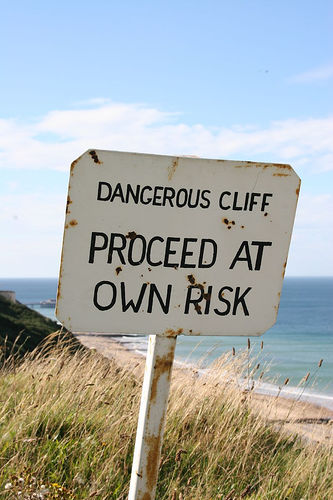
sign: proceed at own risk


In North Carolina, so long as the limitation of liability is not also an agreement to be liable for the other party’s negligence (which is barred as against public policy), such a limitation of liability is enforceable.  A case discussing this issue from the engineering perspective is Blaylock Grading Co., LLP v. Smith et al, 189 N.C. App. 508, 658 S.E.2d 680 (2008).  In that case, a surveying engineer limited his liability, via contract, to $50,000.  The Court, citing an earlier state Supreme Court decision, ruled that the limitation was valid and enforceable:

People should be entitled to contract on their own terms without the indulgence of paternalism by courts in the alleviation of one side or another from the effects of a bad bargain.  Also, they should be permitted to enter into contracts that actually may be unreasonable or which may lead to hardship on one side.  It is only where it turns out that one side or the other is to be penalized by the enforcement of the terms of a contract so unconscionable that no decent, fairminded person would view the ensuing result without being possessed of a profound sense of injustice, that equity will deny the use of its good offices in the enforcement of such unconscionability.  Id. at 511, 658 S.E.2d at 682.

Is this rule absolute?  Clearly not, as the above quote indicates.  Unconscionable limitations will not be enforced.  Moreover, a third party, not subject to the contractual terms, is free to sue in negligence.  But as between the contracting parties, such a limitation on damages can be a powerful tool to minimize exposure to risk.

Questions about limitations on liability?  Comment below or drop me a line.  And be sure to sign up for email delivery of blog posts directly to your inbox.

 ————————

Photo:  “Proceed at own risk” by Dave Nicoll via Flickr/Creative Commons license 

Why should a Designer worry about the Contractor’s insurance issues?

Insurance: not just for Geckos anymore

You may wonder why you, as the designer of record, should care about the insurance coverage of the contractor on your construction projects.  After all, that is an issue between the contractor and the owner, right?  Not so fast.  Recent court cases addressing whether or not commercial general liability (CGL) policies provide insurance coverage for a contractor’s poor workmanship can create problems for architects and engineers.

Since architects and engineers usually have errors & omissions policies (and you do have E&O coverage, right?), they may be the only ones with “deep pockets” should litigation arise over construction defects.   The take-away?  It *is* your business to make sure that the contractors on your projects have sufficient resources to pay for construction defects.  It is also in your best financial interest to ensure that you are only working with top-notch, quality contractors. 

The insurance folks at Victor O. Schinnerer & Company recommend:

More than ever, design professionals should use sound risk management practices when selecting new projects—especially condo projects. Design professionals should insist upon providing full construction phase services and should urge developers to retain contractors using qualifications-based selection procedures. 

I wholeheartedly concur.

Questions?  comments on how Builder CGL policy issues are relevant to your design risks?  Drop me a line.

————————–

Photo: “Geico Gecko”  by Scott Kinmartin via Flickr/Creative Commons License.

Root canals & Lawsuits: two things to avoid (Law Note)

man flossing

No one (with the exception of sadistic dentists)  likes root canals, and no one (except lawyers) likes lawsuits.  In the same way you can prevent (or limit) the need for root canals through proper flossing habits, you can limit the number of lawsuits you need to be involved in if you include everyone you should the first time around.  For those involved in filing construction liens, this means that when you perfect a lien by filing the lawsuit, be sure you include everyone you need to include.  A recent North Carolina Court of Appeals case demonstrates this principle in full living color.

In Lawyers Title Insurance Corp. v. Zogreo, LLC, __ N.C. App. __ (November 16, 2010), two contractors filed and perfected valid liens on a piece of property.  They did not include, in the lawsuits to perfect the liens, the banks which had given funds to the property owner after they first began work on the property.  The Court held that it was entirely proper not to include the banks (who held deeds of trust on the property to secure their loans); however, by the contractors’ failure to include them, they were forced to later litigate priority issues with the banks.  This is because “if a subsequent encumbrancer is not joined [in the underlying lien perfection lawsuit], he is not bound by the judgment in the action between the contractor and the owner.”

In other words, even though they filed proper liens, filed the lawsuits timely, and even won final judgment in those lawsuits, because they did not include the banks, the banks were free to start a new action, which they did in this case.  The banks also obtained an injunction to stop any judicial sale of the property until priorities could be established.

Moral of the story? It is better to include all subsequent encumbrancers (i.e., the banks) when perfecting a lien.  It’s not required, but it is better practice.  (And flossing your teeth isn’t required, either).   After all, who wants a root canal, or, in this case, to re-litigate your right to be paid money in yet another expensive lawsuit?  When it comes to root canals and lawsuits, fewer is better.

Sign up for email delivery of all blog posts directly to your email through the subscription box on the front page of the website.

——————-

Photo: Day One Hundred Fifty-One by Eric Mesa via Flickr/Creative Commons License