Sleep, perchance to get LEED credit? (Tue Tip)

dog sleeping on the job

Sleep.  A subject dear to my heart.  I currently have a coffee mug at work that says: “Eat. Sleep. Read.”  Seriously; that’s what it says.  (h/t to Malaprop’s Bookstore in Asheville for the mug).  What does sleep have to do with the subject of construction law besides, that is, the potential of any legalese to cure insomnia?  LEED-sanctioned nap rooms.

What is that you say? Never heard of such a thing?  Well, now you have.  There is a move afoot to get the USGBC to give LEED credit (that is, green design credit) for buildings that utilize nap rooms.  According to Rob Freeman of green-buildings.com, such nap-specific spaces might qualify in future LEED rating systems based on the proven benefits of napping on employee productivity.

I knew there was as reason I loved my naps….. productivity, of course!

Seriously, do you think a “nap room credit” should become part of a future LEED rating system?  What about the issue raised by a commenter to the article, that the use of the room might change over time, negating the positive impacts?  Share your thoughts below. 

———————————-

Photo:  Sleeping on the Job by SEO via Flickr/Creative Commons license.

Get Your Flu Here! (aka: Don’t Miscommunicate on Your Construction Project!) (Tue Tip)

Continuing our theme from last week’s donkey sign about communicating clearly with your client, today we have another sign to add to our growing collection.  This one is an example of marketing-gone-awry, and comes to us from the good folks at Target:

Flue HQ sign

Now, I’m sure the marketing folks though that “Flu HQ” was a nice little rhyme.  However, I’m not sure Target really wants to be known as the headquarters of the annoying, damaging, and sometimes fatal disease called the flu. 

I’m sure what Target meant by “Flu HQ” was that it carried all of the supplies and medicines needed to help alleviate flu symptoms.  But that’s not exactly what it is saying by this sign.

I can hear some of you now saying that I’m arguing semantics, which is typical for a lawyer.  Remember, though, when it comes to large construction disputes– everyone has a lawyer (or two, or three) and semantics will come into play

Consider this another fair warning to have your construction contracts in place, and vetted by both your attorney and your insurance carrier to prevent miscommunication.

——————————–

Photo in this post: Creative Commons License

Safe Harbors- not just for Sailors anymore (or, why advance planning can prevent claims of defective plans & specs) (law note)

Have you ever considered a “Safe Harbor Provision” for your Owner-Architect or Owner-Engineer contract?  Maybe it is time that you do.

As you are (probably too well) aware, on every construction project there are changes.  Some of these are due to the owner’s change of heart, value engineering concerns, contractor failures, and material substitutions.  Some may be because of a design error, omission, or drawing conflict.  It happens.

safe harbor provisions

A “Safe Harbor Provision” is a provision that establishes an acceptable percentage of increased construction costs (that is, a percentage of the project’s contingency).  The idea is that if the construction changes attributable to the designer is within this percentage, no claim will be made by the Owner for design defects. 

An example provision is provided in the EJCDC documents (Exhibit I, Allocation of Risks, of  Form E-500), which provides

Agreement Not to Claim for Cost of Certain Change Orders: Owner recognizes and expects that certain Change Orders may be required to be issued as the result in whole or part of imprecision, incompleteness, errors, omissions, ambiguities, or inconsistencies in

the Drawings, Specifications, and other design documentation furnished by Engineer or in the other professional services performed or furnished by Engineer under this Agreement (“Covered Change Orders”). Accordingly, Owner agrees not to sue or to make any claim directly or indirectly against Engineer on the basis of professional negligence, breach of contract, or otherwise with respect to the costs of approved Covered Change Orders unless the costs of such approved Covered Change Orders exceed __% of Construction Cost, and then only for an amount in excess of such percentage. Any responsibility of Engineer for the costs of Covered Change Orders in excess of such percentage will be determined on the basis of applicable contractual obligations and professional liability standards. For purposes of this paragraph, the cost of Covered Change Orders will not include any costs that Owner would have incurred if the Covered Change Order work had been included originally without any imprecision, incompleteness, error, omission, ambiguity, or inconsistency in the Contract Documents and without any other error or omission of Engineer related thereto. Nothing in this provision creates a presumption that, or changes the professional liability standard for determining if, Engineer is liable for the cost of Covered Change Orders in excess of the percentage of Construction Cost stated above or for any other Change Order. Wherever used in this paragraph, the term Engineer includes Engineer’s officers, directors, members, partners, agents, employees, and Consultants.

 [NOTE TO — USER: The parties may wish to consider the additional limitation contained in the following sentence.]

Owner further agrees not to sue or to make any claim directly or indirectly against Engineer with respect to any Covered Change Order not in excess of such percentage stated above, and Owner agrees to hold Engineer harmless from and against any suit or claim made by the Contractor relating to any such Covered Change Order.

[Emphasis added to key provisions by me].

Essentially, the EJCDC safe harbor provision includes the following:

  • Owner’s acknowledgement that change orders are standard operating procedure on construction projects
  • Owner’s agreement not to sue or bring any claims against the engineer  unless the costs of such exceed a negotiated percentage of the construction cost.
  • Owner’s acknowledgment that not all change orders over the allocated percentage are the designer’s responsibility, as the aggregate amount does not include costs that the project owner would have incurred if the work covered by the change order had been included originally (the “betterment” to the owner).
  • Owner’s acknowledgement that only the overages attributable to the design are compensable — notably, nothing changes the professional liability standard for determining if the engineer is liable in excess of the percentage. 

Again, this is one of those “don’t try this at home” moments.  A poorly written safe harbor provision could do more harm than good.  It may be seen as establishing a warranty, and that would be an uninsurable loss.  If not properly crafted, it may create the expectation that all overages fall on the designer.  Proceed with caution!

When well-drafted, however, a safe harbor provision can provide you with some level of comfort for the inevitable discoveries that happen when the drawings hit the pavement.

 Have you ever used a “safe harbor” provision in your Owner-Designer agreement?  Did it work to your advantage, or did it create unreasonable expectations that change orders were capped at that amount?  Share your experience below.

———————-

Photo: Boats in safe harbor, Roseau, Dominica via teletypeturtle/Creative Commons license.

Sometimes, ya just gotta tell them the donkey is alive! (Tue Tip)

Recently, I saw a very amusing sign while visiting the farm animal section of the Museum of Life and Science in Durham on an extremely, blisteringly hot summer day.  The sign said:

donkey signIn case you can’t see the sign clearly, it reads:

Sometimes our donkey likes to lay [sic] flat out in the sun.

Don’t be alarmed. . . HE IS STILL ALIVE! (-:

I was very amused that the museum needed a sign proclaiming the non-deathness of its donkey.  However, the sign also struck me as a good tip for all of us involved in the construction business.  Sometimes, you just have to state the obvious.  You may think that it is glaringly obvious that, for example, an extended construction duration will increase the scope of your contract administration fees accordingly.  You might be wrong.  Sometimes it is not obvious, or at least, not something the owner will admit is obvious.  Don’t rely on common sense– go ahead and spell out everything you can in your contract with the Owner.

In the same way the donkey sign keeps the museum patrons from sounding the alarm, a detailed and thorough contract can keep you from having to answer and/or argue about scope of work issues later on.

Sometimes ya just gotta tell everyone in advance that the donkey is alive!

——————————–

Photo in this post: Creative Commons License

Construction Bottomed Out? NOT YET! (Guest Post)

[note: this article was first published on August 8, 2011]

Today we have a guest post by Joel H. Miles, President of Miles Consulting, Inc., a management consulting firm specializing in the construction industry.  Joel has 40 years’ experience in the industry, working in the areas of finance, strategy, operational management, ownership transfer, mergers and acquisitions, valuation, and litigation support.

Joel Miles headshotThe construction industry has been one of the hardest hit by the economic turmoil of the last several years. Generally, non-residential construction is experiencing volume levels roughly half of those of 2007. According to Engineering News Record, the level of unemployment in the industry is 16.3% (in May 2011, compared to 7.4% in 2007).

While there have been a number of bankruptcies already among construction firms, as well as suppliers to the industry, in the last two years, there is reason to believe that there could be a significant number of new failures in the next year. One reason is that for a long time after the onset of the recession, contractors were working off the backlogs of uncompleted work acquired during the strong years of 2005-2007. This has merely postponed the day of reckoning. In an industry traditionally known to have overcapacity, the downturn in the overall amount of work will exacerbate this problem, and inevitably lead to a number of firms “leaving” the market, either voluntarily (strategic decision making) or, more likely, involuntarily (bankruptcy or insolvency). There appear to be a number of general building, specialty trade, and civil contractors who are in financial trouble.

A telling statistical indication of trouble for the immediate future is the Carolinas AGC Construction Activity report for the first quarter of 2011. The dollar amount of construction awards for the first quarter, by category of work, with the percentage change from the same quarter of 2010, are as follows:
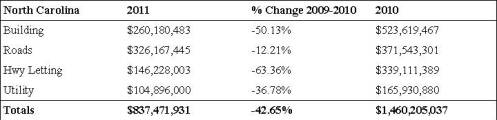
table of NC construction stats

This means that already-depleted backlogs are getting worse, not better. There will be further financial “dislocations”, bonding companies will probably be taking over work where their surety bond customers are unable to complete on-going projects, and construction litigation will almost certainly increase. This is not a pretty picture, and those who have long predicted that the overcapacity problem will be corrected by a reduction in the number of contractors may finally prove their case.

Those with a vested interest the financial health of the contractors and construction industry suppliers (i.e., owners of on-going projects, banks with outstanding construction loans or other loans to contractors, surety companies, and employees of affected contractors) may be in for a period of uncertainty and those with the ability to mitigate the ensuing damage should make every effort to do so.

As with all periods of major change, opportunities are presented. For the strongest in the industry, the time is right for strategic acquisitions (when valuations certainly are favorable to buyers). For banks and bonding companies, active participation may mitigate losses, as opposed to a reactionary stance after the damage has become unavoidable and large. An industry specialist can help.

Joel and I welcome your thoughts and opinions in the comments section, below.